

The Disadvantages of Asphalt

Table of Contents
If you have driven down the street, you have most likely done so on asphalt pavement. It is used to pave roads, freeways, jogging pathways, parking lots and even driveways. Though asphalt is relatively cheap in comparison to concrete or other mediums, it has its disadvantages that should be considered.
Care and Sealing
Asphalt pavement requires more maintenance than concrete, according to the website Home Addition Plus. Every three to five years, asphalt pavement must be resealed to prevent cracking. Sealers must be applied and then the surface left alone for two to three days before cars can drive on the surface. Resealing the asphalt surface every three to five years will cost money and time.
Cracks
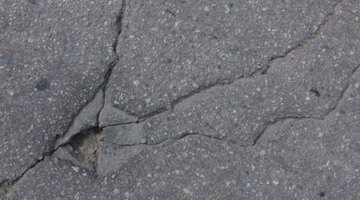
When asphalt is not laid properly, it is prone to cracks and pitting. Issues such as uneven pavement surfaces, inadequate mixing and laying pavement over previous cracks are all reasons cracks will occur, according to a study from the University of Florida.
Construction
In order for traditional asphalt to be used, it must first be heated to 250 to 350 degrees Fahrenheit, according to the U.S. Forest Service. At these temperatures asphalt is fluid and will bond with the surface it is applied to. Immediately after asphalt is poured it must be covered with sand or aggregate in order for it to stick properly. Substantial training of installers is required.
Environmental Issues
Asphalt is created from petroleum. In this process, hydrocarbons are released, which in turn lead to pollution. The most commonly used asphalt for roadways and parking lots is known as coal tar. Cutback asphalts are used to create asphalt cements, which can also be used in parking lots and driveways. Cutback asphalts emit a higher amount of hydrocarbons than emulsion asphalts.
Equipment
Asphalt, no matter the type used, requires heavy equipment to install. Distributor trucks, sand spreaders, paving equipment and graders are all needed in order to lay asphalt surfaces properly and smoothly. This type of equipment can be rented in small-scale form for a driveway project, but it is costly. Large-scale projects require heavier equipment, which can be cost-prohibitive.
The Drip Cap
- If you have driven down the street, you have most likely done so on asphalt pavement.
- Sealers must be applied and then the surface left alone for two to three days before cars can drive on the surface.
- Asphalt is created from petroleum.
- Cutback asphalts are used to create asphalt cements, which can also be used in parking lots and driveways.
- This type of equipment can be rented in small-scale form for a driveway project, but it is costly.
References
Writer Bio
Shailynn Krow began writing professionally in 2002. She has contributed articles on food, weddings, travel, human resources/management and parenting to numerous online and offline publications. Krow holds a Bachelor of Science in psychology from the University of California, Los Angeles and an Associate of Science in pastry arts from the International Culinary Institute of America.
Photo Credits
- Jupiterimages/Photos.com/Getty Images
- Jupiterimages/Photos.com/Getty Images
More Articles

