
-
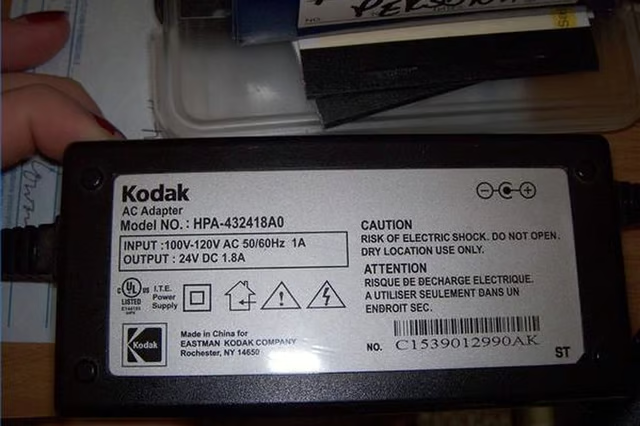
Calculate the appropriate circuit breaker requirements for your home by segmenting each area of the house as it would appear on the circuit breaker: kitchen, living room, master bedroom and other rooms. You then use either a calculation for a specific area and household items, or you can add up the items based on whether they have stickers listing amps and wattage.
-
Find the wattage or amps for a specific item. For example, to find out what amps are required for a basic 75-watt light bulb, use the calculation Watts = Volts x Amps, or W = V x A.
-
Calculate or add up the amps on each stickered item included in the area for a specific circuit breaker. For example, a 75-watt light bulb, based on the calculation in Step 2 is 0.625 amps. This is assuming that almost all home appliances except large appliances are 120V (volts).
-
Add up all the amps. Let's say you need a total of 20 amps to run a certain area of the house. You would need a circuit breaker that can handle 20 amps.
-
Obtain a circuit breaker that can cover 20 percent more than your amp calculation so that it won't short out or have too little amperage, causing the circuit breaker to trip or even start a fire if it's running too hot.
The Drip Cap
- This article will help you understand the steps needed to size a circuit breaker to your home's specifications.
- For example, to find out what amps are required for a basic 75-watt light bulb, use the calculation Watts = Volts x Amps, or W = V x A.
- Calculate or add up the amps on each stickered item included in the area for a specific circuit breaker.
- For example, a 75-watt light bulb, based on the calculation in Step 2 is 0.625 amps.