


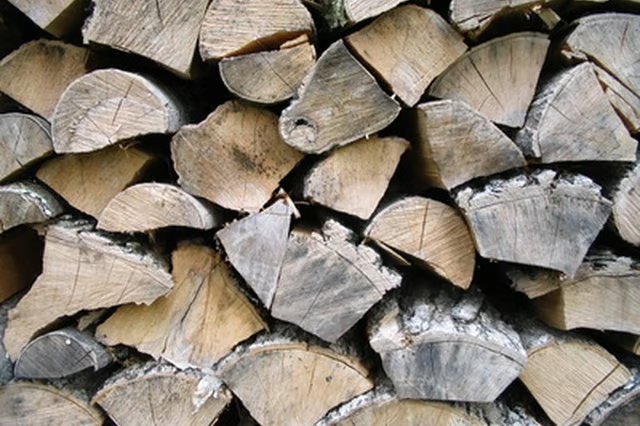
It reduces the amount of space between the individual pieces, thereby giving you the largest quantity for your money. You should only measure wood that is properly ranked.
-
Rank the pile of firewood. Firewood is commonly measured by the “cord,” which is 4 feet high, 4 feet wide and 8 feet long. Stack separate pieces of firewood parallel to each other so that the pile measures 8 feet long, 4 feet high and 4 feet wide. If you don’t have that much firewood, stack the pile so it is 8 feet long, 4 feet high and however wide you want it.
-
Measure the rank of firewood. Use a measuring tape to measure the height, length and width of the pile. Multiply all three together to get the cubic feet of the pile. For example, a 4 foot high, 4 foot wide and 8 foot long pile is 128 cubic feet.
-
Divide the cubic feet by 128 to get the number of “cords” you have. For example, 128 cubic feet would be one cord of firewood. If your pile is 4 feet high, 8 feet long and 2 feet wide, then you have a pile measuring 64 cubic feet, which is half of a cord.
-
Divide the cubic feet by 110 if your wood is sawed instead of whole logs. For example, a pile of wood measuring 55 cubic feet is half of a sawed cord of wood.
-
Divide the cubic feet by 120 if your wood is sawed and split instead of whole or just sawed logs. For example, a pile of wood measuring 60 cubic feet is half of a sawed and split cord of wood.
-
Use the cubic feet of the pile or the number of cords to sell or purchase firewood at a fair price.
The Drip Cap
- Be wary of buying wood that is cross-stacked as you may be getting a bad deal.
- Measure the rank of firewood.
- If your pile is 4 feet high, 8 feet long and 2 feet wide, then you have a pile measuring 64 cubic feet, which is half of a cord.
- Divide the cubic feet by 110 if your wood is sawed instead of whole logs.
- For example, a pile of wood measuring 60 cubic feet is half of a sawed and split cord of wood.