


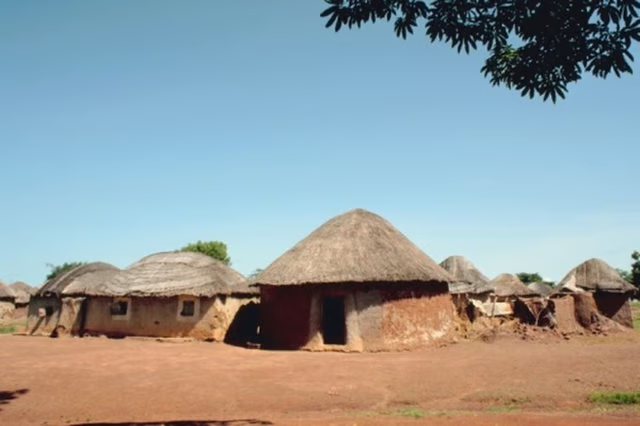
Mud huts can be for survival or as an alternative – and economical – way to build a house. It is a project you can do with minimal amount of preparation.
Things You Will Need
-
Find an appropriate site. Tom Brown Jr. suggests that an elevated, well-drained site that is at least 50 feet from water that could flood the hut is ideal. Further advice is to look for a spot that is sheltered by trees of rocks, but not in the forest as you want light.
-
Draw a blueprint of your hut before you start building. It can be a simple mud hut, like those found dotted across the landscape in West Africa, or a more elaborate construction. Plan where you are going to put the door and at least one small window – although you can have more – for ventilation.
-
Cut straight poles for the frame and to hold up the roof. Cut V-notches in the sidewall poles to anchor the wooden frame you are going to use to hold up the roof. Pick the strongest pole – because it has to support considerable weight -- to serve as a horizontal beam that will run across the roof. Also use stronger poles for the door frame.
-
Dig holes about a foot deep and 8 to 10 inches apart to anchor your hut. Put the poles in the holes and fill them. Add the poles for the roof and then secure your cross beam, which should be longer than the frame and stick out on both ends for extra safety. Lash the beam to the frame with cord to keep it in place.
-
Plan your roof. Cut saplings for the roof and lay them side-by-side opposite to the beam. If the beam faces north and south, the saplings will face east and west. Another roof option for your mud hut is to use sod, as the early settlers on the prairies did when they built huts. Yet a third option is to use thatch, like the African huts.
-
Gather rocks that will fit between the poles of the hut. Adding rocks as you build the walls of the hut will help the mud adhere to the poles.
-
Mix the mud – the thicker the better – and add grass. Tom Brown Jr. recommends a mixture of one part dried grass to two parts mud. Clay works particularly well as it sticks better than other types of soil.
-
Layer the rocks and the mud mixture between the poles and also in front and behind them. Make the base of the wall thicker for the first two feet for added stability. Keep adding more mud mixture until you get to the roof.
-
Finish the roof according to your original plan. For the inside walls, slather mud without dried grass for a more finished look. Attach a ready-made door to the door frame.
The Drip Cap
- Mud huts can be constructed in any climate and are ideal shelters as they are warm in winter and cool in summer.
- Further advice is to look for a spot that is sheltered by trees of rocks, but not in the forest as you want light.
- Lash the beam to the frame with cord to keep it in place.
- Yet a third option is to use thatch, like the African huts.
- Adding rocks as you build the walls of the hut will help the mud adhere to the poles.
- Mix the mud – the thicker the better – and add grass.
- For the inside walls, slather mud without dried grass for a more finished look.