
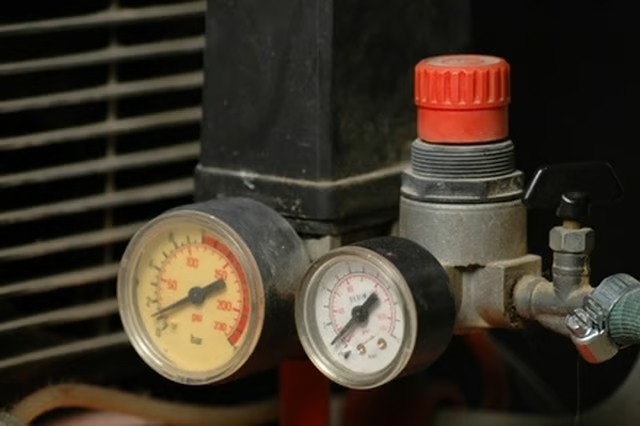


Compressor Function
Compressors supply pressurized air for inflation, power tools and machines of every description. They are rated by specifying their output volume in standard-cubic-feet-per-minute (SCFM) units at a given output pressure. Most pneumatic tools use compressed air in the 90-to-120-pound-per-square-inch (psi) range, which is within the efficient reach of a single-stage compressor, up to about 135 psi. A compressor's SCFM volume capacity would tell a contractor how many carpenters could run their pneumatic nail guns, with specified volume requirements of their own, from one compressor at the same time.
Twin-Cylinder Function
Twin-cylinder compressors are single-stage compressors with two cylinders of equal size that work in parallel simply to double the volume of the output air in the 90-to-120-psi range. Having twice as many cylinders of the same size as a single-cylinder compressor would double the number of carpenters that could work from the same source. It would be less expensive than purchasing two compressors.
Dual-Stage Function
Dual-stage compressors accomplish their compression process in two separate steps. Instead of the two cylinders working in parallel, they work in series. When the first-stage cylinder is finished compressing a charge of air, it pushes it to an intercooler radiator to lose most of its compression heat. The same charge is passed to the second cylinder, which takes the air the rest of the way to the compressor's output pressure rating. Dual-stage compressors are capable of supplying air at much higher pressures than single-stage units because both stages are operated in their optimal efficiency zones.
Physical Differences
The two cylinders in a twin-cylinder air compressor supply the same amount of air at the same pressure and perform the same amount of thermodynamic work, so they are identical in size and shape. In contrast, the two cylinders in a dual-stage, two-cylinder compressor operate at completely different pressures, temperatures and on different volumes, although the mass flow is equal because they are in series. So the second cylinder must be smaller than the first in order that the work load between the cylinders is equal, which dynamically balances the machine.
Economic Considerations
The choice between twin-cylinder compressors and dual-stage compressors is clear whenever the required output pressure is below 90 psi, where a twin-cylinder unit works fine, or above 135 psi, where the dual-stage unit is required. The confusion and arguments come in whenever the application lies between these two zones in the 90-to-135-psi realm. From a capital expenditure standpoint, the dual-stage unit of the same capacity rating will be more complex than the twin-cylinder unit and more expensive to purchase and maintain. From an energy-usage and operating perspective, the dual-stage unit will be more economical to operate because both cylinders operate in their optimal range.
Usage Considerations
It often turns out that twin-cylinder units operating only occasionally or intermittently in the 90-to-135-psi realm are the best choice. For continuous duty, or where an industrial operation is completely dependent on a reliable source of air in this pressure range, the dual-stage unit will be operating in its ideal zone and should be selected.