Things You Will Need
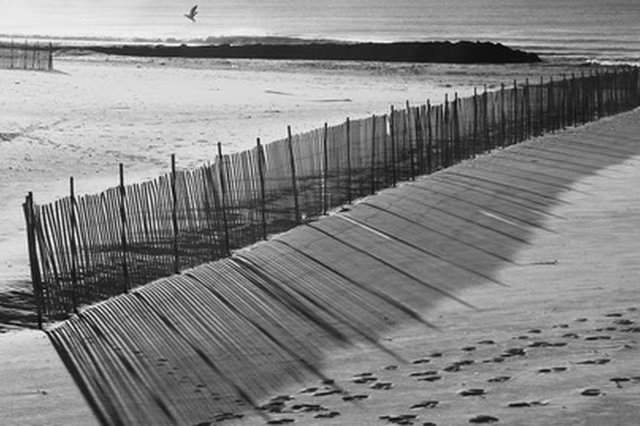
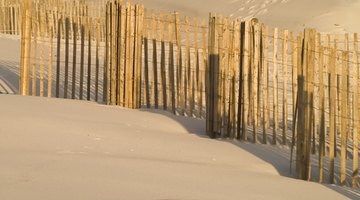
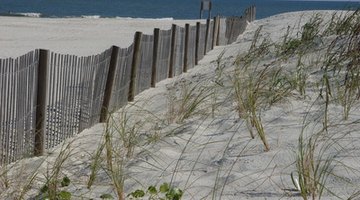
Such fences are used to form dunes where they are wanted or to prevent sand from being blown where it is not wanted. Sand fencing can be an effective tool to restore and stabilize dune formation along shorelines. Sand fences also can be used in desert settings to prevent erosion and to minimize sand drift on to roads.
Location
-
Contact your state's Department of Natural Resources to determine whether or not there are guidelines or regulations governing the installation of sand fences in your area if you want to install a sand fence on a coastline.
-
Find the crest of the primary or frontal dune. If you will install the fence parallel to a shoreline, choose a line on the land side and not the water side of this primary dune.
-
Do not install the fence on a wet sand beach. It will be vulnerable to waves.
-
Roll out the fence material, whether wood slat or plastic mesh, the length of the site where you plan to install it.
Installation
-
Soak with water the specific sites where you dig the fence post holes. This will help prevent the soft sand from falling back into the hole as you dig. Fence posts should be 8 feet apart, except for the two end posts, which should be 6 feet from the post nearest them.
-
Dig holes for the fence posts. For a 4 foot fence, plan to leave about 4-1/2 feet of the post above the sand, as a small gap will be left between the bottom of the fence and the surface of the sand.
-
Place a fence post into each hole and hammer it in to secure the post before shoveling sand back into the hole. Tamp down the sand around each post before moving on to work on the next post. Again, the posts should be 8 feet apart, except for the end posts, which should be 6 feet from the nearest post.
-
Attach the top of the fence to the top of the posts, starting at one end and working toward the other end. Tie the fence in place with a wire fence tie.
-
Pull wood slat fences taut to at least 250 pounds per foot. Synthetic fence material should be pulled taut to manufacturer specifications.
-
Leave a gap of 4 to 8 inches between the bottom of the fence and the top of the sand's surface.
-
Secure the bottom of the fence to each post with wire fence ties. Secure the middle of the end posts also with fence ties. Use wire for additional strength, as needed.
-
For synthetic fences, sandwich two 2-by-2-inch, 6-foot-long wood boards around the metal fence posts, burying the excess length of the wood beneath the sand's surface. Wire the wood securely into place at each end of the metal post and again in the middle.