

Solid Vs. Veneer Cabinet Doors

Buying kitchen cabinets can be a major investment for many homeowners. Because of the high price tag associated with this process, it is important to understand the different types of cabinets available. One of the biggest decisions to make when choosing cabinets is whether to use solid wood or veneer construction. Though these two methods produce similar results, each has its own benefits and drawbacks that should be considered before making a selection.
Construction
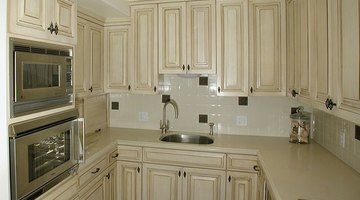
Solid wood cabinet doors are made from planks of lumber joined together to form a continuous surface. Veneer doors are made from a plywood or composite base topped with a thin layer of wood veneer. Rather than cut lumber into planks to make veneer doors, a thin layer of wood is shaved off the log. This thin layer is glued to the top of the composite base to give the look of solid wood. Because they are both made from real wood, it can be difficult to tell a veneer door from a solid wood version, even when viewed up close.
Appearance
Veneer cabinet doors will usually have a more consistent and uniform appearance than that of solid wood. The grain pattern will be more even, and will match adjacent doors more closely. Solid wood, on the other hand, will show natural flaws and inconsistencies. Both can be stained to match existing cabinets or to complement the look of a room. For many, the difference in appearance between the two is a matter of personal taste.
Maintenance
Because of their composite base, veneer cabinet doors will hold up better against humidity and temperature changes. They are less likely than solid wood to swell or warp. At the same time, veneer is typically quite thin, and is susceptible to damage in the form of chipping or peeling. While wood can be sanded and refinished, veneer must be completely replaced if damaged or faded.
Cost
Wood cabinet doors are almost always more expensive than veneer in terms of upfront costs. When lifetime costs are considered, wood may be the cheaper option. It will last for many years without needing replacement, and can be refinished as needed to refresh its appearance. Veneer will usually not last as long, and will need to be replaced much more often.
Environmental Factors
Cutting a log into planks for cabinet construction tends to result in a great deal of wasted wood. Veneer manufacturing is much more efficient and results in less waste. Because veneer uses only a thin layer of real wood, it is an environmentally friendly way to get the look of exotic wood species without cutting down as many trees.
Considerations
Laminate is a third alternative to solid wood or veneered cabinet doors. It is made from a composite base with a printed paper top layer. The paper is printed to resemble real wood grain, then sealed with a clear coating for strength and protection. Laminate can be used to create an ideal wood grain with perfect uniformity and consistency. It also lasts for many years with little to no maintenance. The biggest drawback to laminate is that it is not real wood, and can have an unnatural look and feel that keeps some buyers away.
References
Writer Bio
Emily Beach works in the commercial construction industry in Maryland. She received her LEED accreditation from the U.S. Green Building Council in 2008 and is in the process of working towards an Architectural Hardware Consultant certification from the Door and Hardware Institute. She received a bachelor's degree in economics and management from Goucher College in Towson, Maryland.
Photo Credits
- Nancy Hugo: Flickr.com
More Articles

