


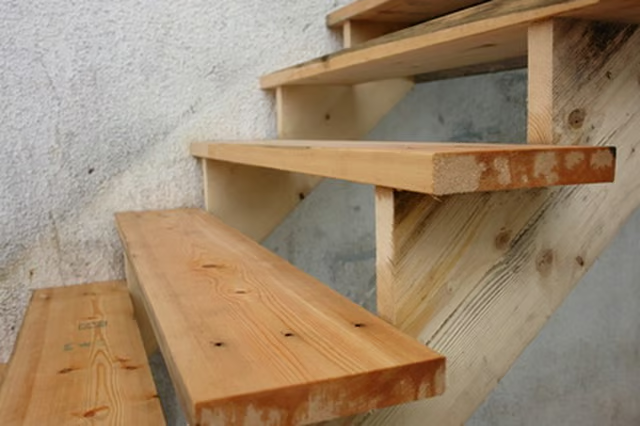
Fortunately, there are many such fasteners available that can be used in holes that you pre-drill in the concrete. The most secure fastener uses a metal sleeve that wedges in the hole as you tighten the bolt.
Things You Will Need
-
Measure the distance from the outside edge of one stringer to the outside edge of the other and use a handsaw to cut a kick-plate to this length from 2-by-4 pressure-treated lumber.
-
Mark the position of the stringers on the concrete landing and set the kick-plate on these marks. Use a hammer-drill and a masonry bit to drill two 1/2-inch holes through the kick-plate into the concrete to insert 1/2-inch metal-sleeve anchors. Drill the holes deep enough into the concrete so that the tops of the sleeves will be flush with the surface.
-
Remove the bolts from the sleeves and slide the sleeves into the holes in the concrete. Set the kick-plate in position and use a wrench to tighten the hex heads of the bolts into the sleeves, affixing the kick-plate onto the concrete.
-
Cut notches out of the front of the stringers with a hand saw so that they fit over the kick-plate. Set the stringers in place and attach them to the kick-plate with L-brackets and 1 1/4-inch screws.
The Drip Cap
- In order for a wooden stairway to be safe, the stringers (support boards) should be securely fastened to both the upper and lower floors.
- When the lower floor is made of concrete, you will need a special fastener to attach the wood to it unless one has already been embedded for this purpose.
- Set the stringers in place and attach them to the kick-plate with L-brackets and 1 1/4-inch screws.