


Vacuum Cleaners 101
In vacuum cleaners, a fan in a narrow casing rotates rapidly to catch and force air into the vacuum bag. The pull created by the fan draws the air over the surrounding ground, decreasing its pressure. Meanwhile, the greater atmospheric pressure "pushes" the dust and dirt up into this low-pressure zone. Therefore, what we perceive as the "force" of a vacuum cleaner's suction is really just force of the atmosphere pushing against the low-pressure interior created by the motorized fan.
Water And Air Pressure
In chemistry, the boiling point of a liquid relies heavily on the surrounding air pressure. For example, at sea level (i.e. zero feet of elevation above the earth's surface) water boils at 100 degrees Celsius. But a mile above sea level, water boils at 98 degrees Celsius because atmospheric pressure decreases with altitude.
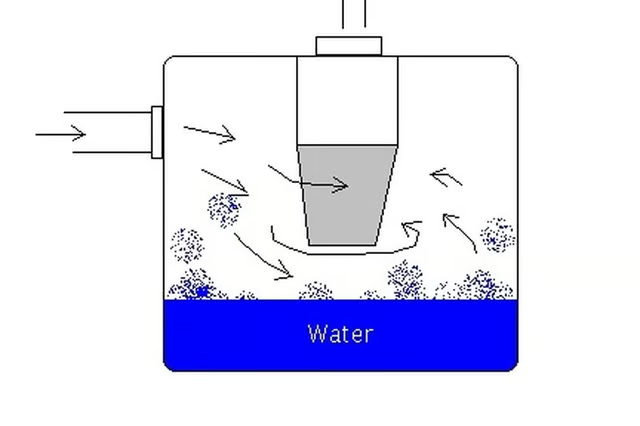
In a water filtration vacuum, the hose attaches to the main body of the vacuum, which consists of a fan motor suspended over a shallow basin of water (Figure 1). The motor moves air at a high speed, decreasing its pressure and, by extension, the pressure inside the main body. Like a typical vacuum, the higher-pressure atmosphere "pushes" air into the low-pressure machine. However, in a water filtration vacuum, the low-pressure conditions inside the machine cause the water to aggressively vaporize or "boil".
How Water "Filters" The Air
This aggressive, albeit low temperature, vaporizing creates an extremely humid environment inside the vacuum. When the dirt, dust, pollen and other tiny impurities in the air are suctioned into the main chamber, the droplets of water either bond to or outright dissolve them. Meanwhile, the motor is surrounded by a special hydrophobic filter that repels water. The filter allows gases such as nitrogen, oxygen, argon and carbon dioxide to pass through while the water-bonded dust and dirt particles get trapped and drip back down into the basin.
To clean, simply open the body and pour out the dirty water. The filter never needs to be changed!